Get Started with
Blockdaemon Today!
Contact us to learn how we can help you power your blockchain business.

Unparalleled Security & Compliance
Seamless Integration & Scalability
Dedicated Customer Support

Learn how Harmonic gives Solana validators more control over block-building, builder selection, scheduling strategy, and staking reward economics.
.png)
As discussed in our previous blog on SIMD-123, upcoming Solana protocol changes are expected to make block rewards and MEV-related rewards more relevant to SOL staking economics. That makes block-building infrastructure more important for institutional stakers evaluating validator performance, reward generation, and long-term PRR.
In our previous blog on JitoBAM, we looked at how block assembly is becoming a more important part of Solana staking. Harmonic fits into the same broader shift, but from a different angle. JitoBAM focuses on a structured transaction pipeline with privacy, attestations, and programmable plugins. Harmonic focuses on validator choice: which builder constructs a validator’s blocks, and which scheduling strategy the validator uses.
Harmonic is a highly configurable block-building system for Solana. Its core premise is that validators should decide how their blocks are built, including which builder they use and which scheduling strategy they run. For institutional stakers, the relevance is that Harmonic may influence how validators source blocks, manage block-building risk, and explain PRR differences over time.
Harmonic is block-building infrastructure for Solana. It connects validators to block builders and gives validators control over how their blocks are constructed.
Instead of relying on a single block-building path, Harmonic lets validators choose a builder and scheduling strategy. The system is designed to support validator-level policy control, configurable scheduling, and failover if block-building infrastructure becomes unavailable.
Harmonic consists of four core components that work together to deliver blocks to validators through streaming:
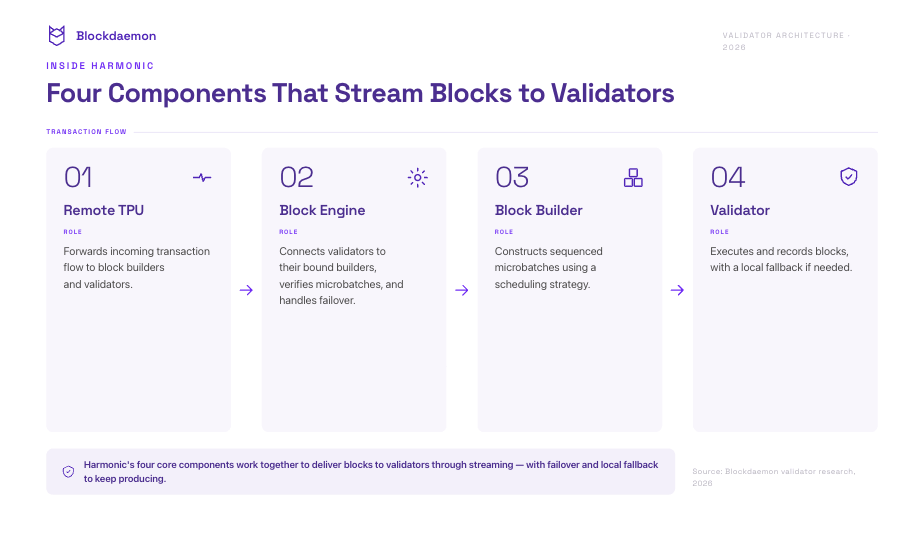
Source: Harmonic Architecture
The key point is that Harmonic is not another validator client. It is infrastructure for block-building selection. Validators can decide which builder and scheduling strategy best fit their operating goals, delegation requirements, and reward strategy.
As Solana scales, validators need to build blocks efficiently, include valuable transactions, and avoid policies that harm users or the network. Harmonic’s premise is that reliance on specialized or centralized block builders can create four problems: limited competition, reduced validator control, centralization risk, and less efficient markets.
Harmonic’s answer is validator autonomy. It highlights that validators, not Harmonic, decide how their blocks are built. A validator can choose its scheduling strategy and builder, while Harmonic provides the infrastructure for that choice.
For institutional stakers, this means validator evaluation may increasingly include block-building policy alongside uptime, commission, security, and reporting.
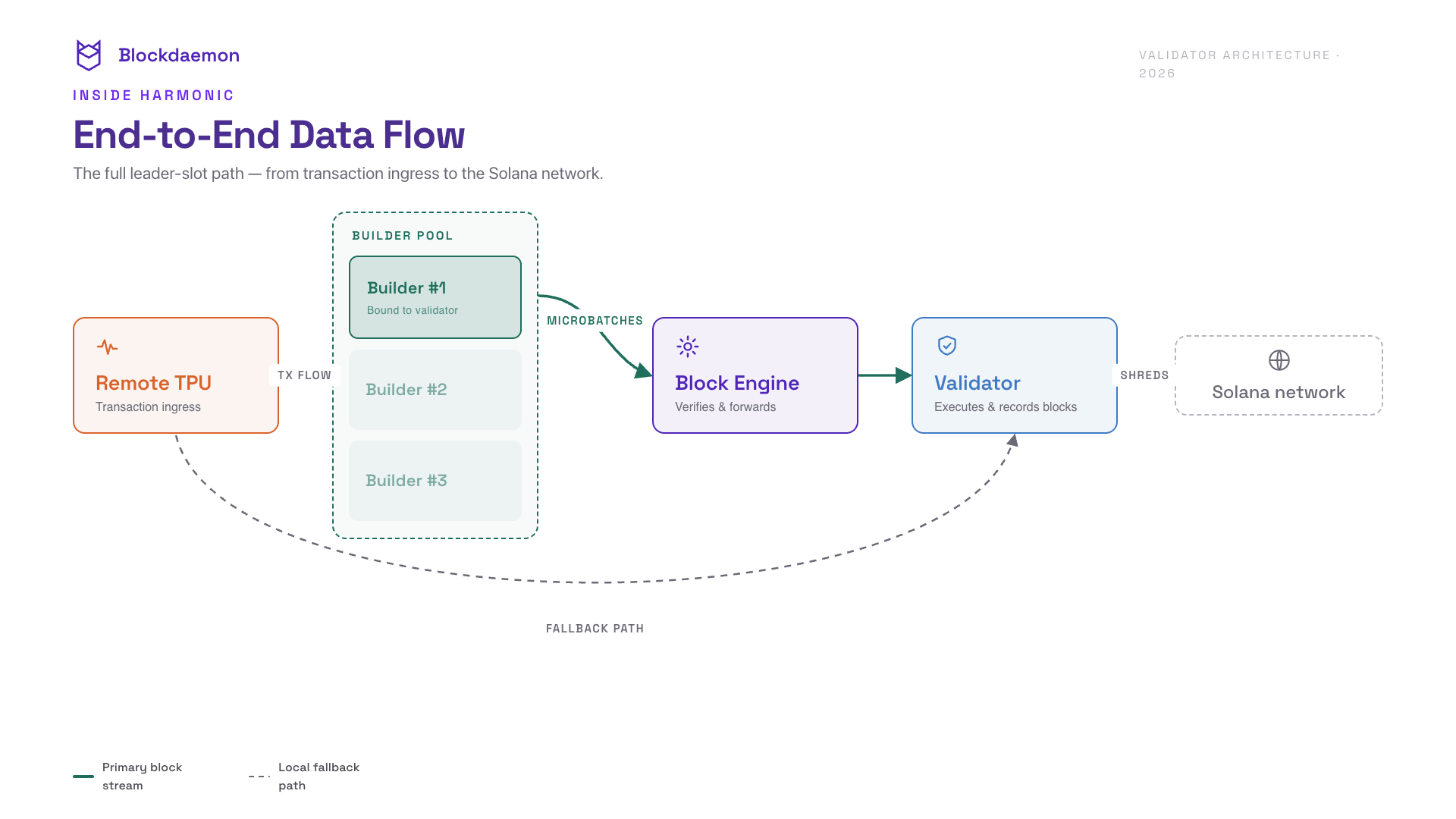
Source: Harmonic’s End-to-End Data Flow
Harmonic’s data flow starts with the Remote TPU, which forwards transaction flow to validators and block builders. Builders then construct ordered transaction batches using the validator’s selected scheduling strategy. The Block Engine verifies and routes builder output to the validator, which executes the block and broadcasts it to the Solana network.
The important design point is fallback. If the selected builder path becomes unavailable, Harmonic can fail over to another builder using the same strategy. If that is not available, the validator can fall back to local block construction. For institutional stakers, this matters because Harmonic is designed not only for builder choice, but also for operational resilience.
A scheduling strategy determines how transactions are ordered before a block is built. Different strategies can prioritize different outcomes, including fee capture, fair ordering, delegation-program compliance, or custom policy requirements. Harmonic’s Scheduling Strategies docs define a scheduling strategy as the algorithm a builder uses to decide which transactions to include in a slot and in what order.
Harmonic’s FAQ highlights configurability as a key differentiator. Harmonic gives operators a choice of scheduling strategies, including FBA, FIFO, MREV, and custom strategies, so validators can select the approach that fits their stake and delegation requirements.
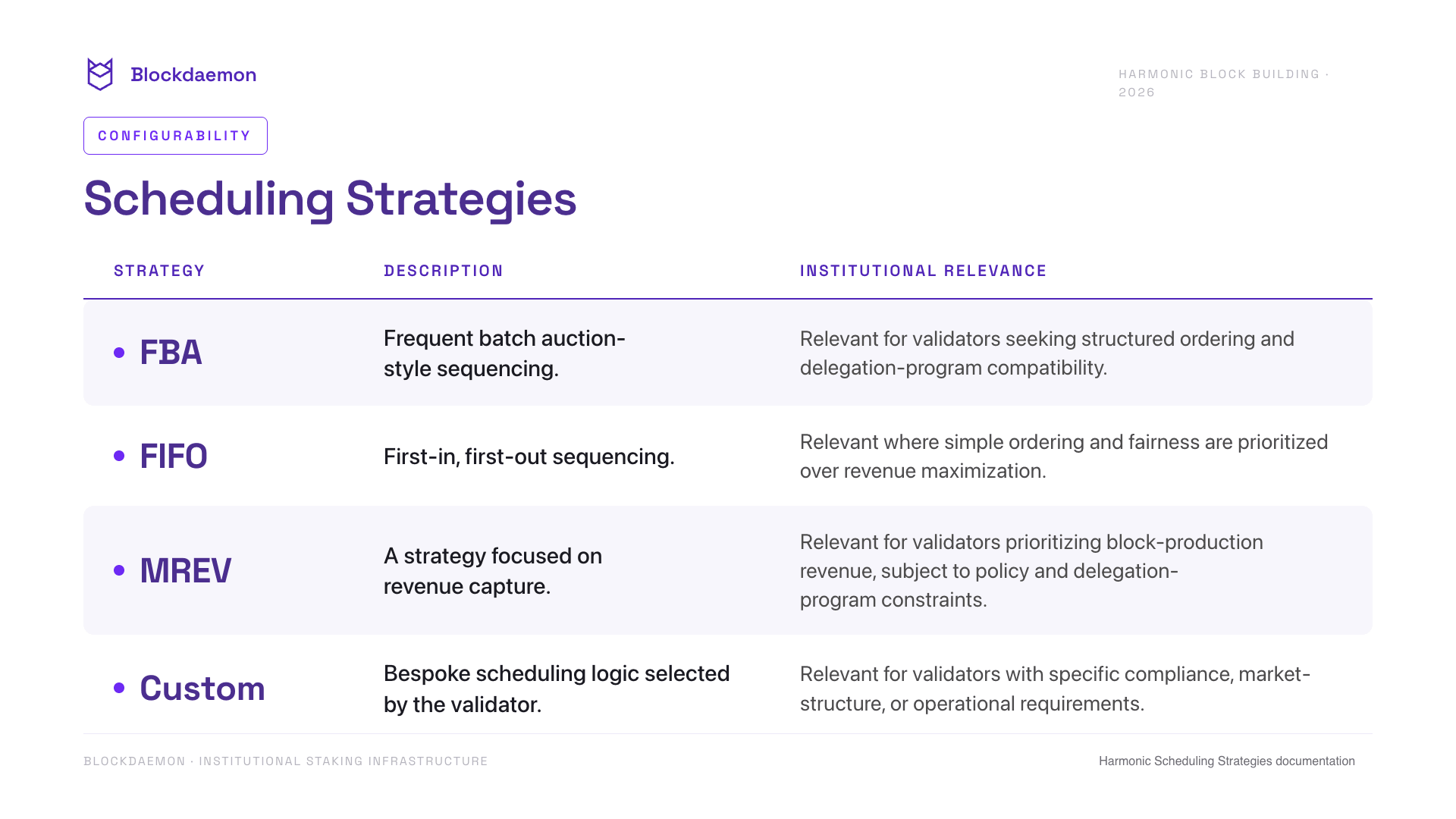
A validator may optimize for higher block-production revenue, while institutions may also care about fairness, network health, risk exposure, and whether the strategy is consistent with delegation-program or compliance expectations.
JitoBAM and Harmonic are both part of Solana’s shift toward more advanced block-building infrastructure, but they address different parts of the stack.
JitoBAM is focused on a structured transaction pipeline. It uses BAM Nodes, BAM Validators, and Plugins to bring privacy, verifiability, and programmability to Solana block construction. Jito describes BAM as a “high-performance block-building architecture that brings verifiability, privacy, and programmability to Solana’s transaction pipeline.”
Harmonic focuses on builder selection and scheduling choice. Instead of emphasizing one transaction pipeline, it gives validators a configurable way to choose builders and ordering strategies.
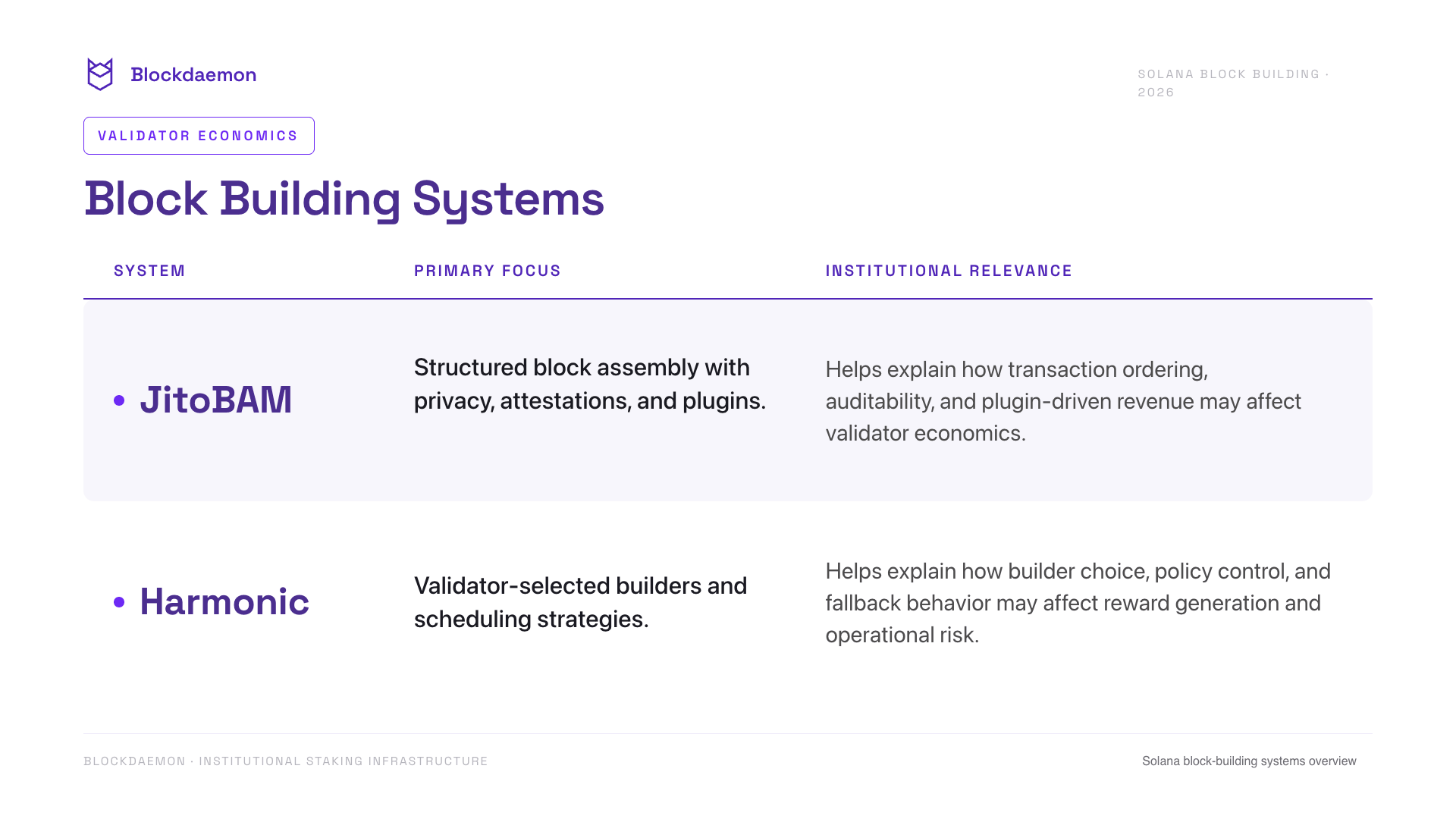
In simple terms, JitoBAM focuses on improving the block assembly path. Harmonic focuses on giving validators more choice over block construction.
Harmonic is designed to improve validator revenue potential by increasing builder competition and giving validators more control over scheduling strategy.
This is especially relevant in the context of SIMD-123, which introduces a mechanism for validators to share part of their block revenue with delegators through protocol-calculated post-commission rewards. If block rewards and MEV-related rewards become more relevant to delegators, then the infrastructure used to generate that revenue becomes more relevant as well.
Harmonic does not guarantee higher rewards. Validator outcomes still depend on builder selection, scheduling strategy, network conditions, commission, reward-sharing terms, and operational execution. Its relevance is that it makes block-building strategy a clearer part of validator performance.
For institutional stakers, Harmonic adds one specific dimension to traditional validator selection: how validators source and construct blocks.
As Solana staking matures, PRR differences may increasingly reflect more than uptime and commission. They may also reflect builder choice, scheduling strategy, block-production performance, exposure to transaction flow, and how block revenue is shared.
Harmonic does not replace the fundamentals of validator evaluation. Uptime, security, commission, and reporting still matter for both network health and validator performance. But block-building strategy is becoming harder to ignore.
To discuss your Solana staking strategy, book a call with the Blockdaemon team.


Contact us to learn how we can help you power your blockchain business.