Get Started with
Blockdaemon Today!
Contact us to learn how we can help you power your blockchain business.

Unparalleled Security & Compliance
Seamless Integration & Scalability
Dedicated Customer Support

EIP-8363 proposes burning a rising share of Ethereum staking rewards, cutting issuance from about 2.6% to 1.2% of staked ETH and to zero at half of supply.
Published in August 2026, EIP-8363, titled "Tapered Issuance Burn," proposes burning a growing share of validator rewards as more ETH is staked. The burn rises until new issuance stops completely once roughly half of all ETH is staked.
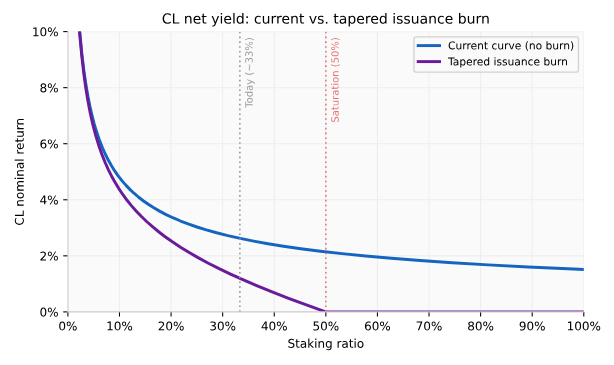
The effect on staking rewards would be large. By the proposal's own figures, applying the burn in full at today's staking ratio would cut annual issuance rewards from about 2.6% of a validator's staked ETH to 1.2%, a drop of more than half. To soften that, the burn phases gradually, in 65 small steps over roughly 18 months.
Today the proposal is a draft under review.
In this blog, we take a closer look at what this proposal could mean for institutional Ethereum staking rewards.
Ethereum validators earn rewards from two sources. The first is issuance, newly created ETH the protocol pays them for proposing and attesting to blocks. The second is execution income, the priority fees and MEV that users pay to have their transactions included. Issuance dominates. At today's staking levels, it makes up at least 93% of staking rewards, with execution income adding at most about 0.20% on top.
Issuance follows a curve with no off switch. The reward rate falls as more ETH is staked, but it never drops below roughly 1.5%, no matter how much is staked. The protocol keeps paying for new stake indefinitely, even as more is committed.
The proposal keeps every reward and penalty exactly as it is, then burns a fraction of each validator's issuance rewards at the moment they are paid. The fraction rises with total staked ETH and reaches 100% at 60.25 million ETH staked, about half of supply. At that point the network would issue no new ETH at all. Execution income is untouched, so validators keep every priority fee and MEV payment.
The change would not arrive at once. The burn phases in over roughly 18 months, and with the usual lead time before a network upgrade, the authors state that participants would have about two years to adjust.
Source: The proposal’s Github
At today's staking ratio, net issuance rewards fall from about 2.6% to 1.2% once the burn is fully phased in, and they keep falling if more ETH is staked. Because the burn touches only issuance, priority fees and MEV still flow to validators in full, which makes performance and MEV capture a bigger factor in the rewards each staking provider delivers. Issuance would remain the anchor, though. Even so, issuance would remain the largest source of staking rewards. If staking grew to 40% of all ETH, the authors calculate issuance would still provide at least 80% of the total.
The reduction has an offsetting benefit. Issuance dilutes every ETH holder, staked or not, and the proposal caps that. Under the taper, total issuance peaks at a staking ratio of roughly 20% and falls beyond it, so supply grows more slowly than under the current curve. Lower rewards come with lower dilution, and more of the reward that remains is real.
Today, Ethereum staking rewards are set by a fixed curve. Under EIP-8363 they would be set by the market. If rewards fall too low and stakers exit, total stake drops, the burn fraction shrinks, and the reward rate rises for everyone who remains. The authors argue staking would settle below half of supply, at whatever reward rate stakers actually require.
Ethereum has no token vote, so there is no single approval moment. A change like this must clear four gates in sequence. First, the EIP document must advance from Draft status under the EIP editors, who have already requested changes to this one. Second, core developers must agree on their public calls to include it in a named network upgrade. Proposals enter that process at a stage called "proposed for inclusion," and EIP-8363 did not reach even that first stage for Hegotá, the upgrade that follows Glamsterdam. Third, every consensus client team must build and test the change. Fourth, it ships in a hard fork that node operators and stakers adopt. The debate happens in the open, on the Ethereum Magicians forum and the biweekly core developer calls, which is where any change in status will appear first.
Even in a best case, the design rules out a fast rollout. The proposal states that scheduling would be announced at least six months before going live, followed by the 18-month phase-in, giving stakers on the order of two years to adjust from the moment Ethereum commits to the change. With no upgrade slot today, that clock has not started.
EIP-8363 would end Ethereum's guarantee that staking always pays. New issuance would stop entirely if staked ETH ever reached 60.25 million, about half of supply, with the burn phased in over roughly 18 months. Priority fees and MEV would be untouched, and total issuance would peak and then fall, so dilution eases alongside rewards. Institutions staking ETH should still test their reward models against the tapered curve now, because the debate shows where influential Ethereum researchers want issuance to go.
To discuss your ETH staking strategy, book a call with the Blockdaemon team by filling out the form below today.


Contact us to learn how we can help you power your blockchain business.