Get Started with
Blockdaemon Today!
Contact us to learn how we can help you power your blockchain business.

Unparalleled Security & Compliance
Seamless Integration & Scalability
Dedicated Customer Support

At ETHConf 2026, held June 8-10 in New York City, Demetrios Skalkotos, Chief DeFi & Protocols Officer at Blockdaemon, spoke about the next phase of institutional ETH staking.
.jpg)
At ETHConf 2026, held June 8-10 in New York City, Demetrios Skalkotos, Chief DeFi & Protocols Officer at Blockdaemon, spoke about the next phase of institutional ETH staking.
The presentation focused on a practical point for treasury teams, asset managers, ETF issuers, custodians, and public companies: ETH staking brings operational demands that need to be handled with care.
ETH can generate protocol rewards through staking. That gives it a role in treasury planning that goes beyond holding an asset on a balance sheet. It also adds new responsibilities around key control, validator operations, sanctions screening, liquidity planning, slashing cover, tax reporting, and uptime.
The market is already moving in this direction. ETH ETFs are creating new access points for institutional capital. BlackRock has been one of the most visible firms exposing ETH fund holders to staking rewards. More than 30 Nasdaq-listed companies now hold digital assets on their balance sheets. Public companies collectively hold around 7 million ETH, equal to roughly 6% of total ETH supply.
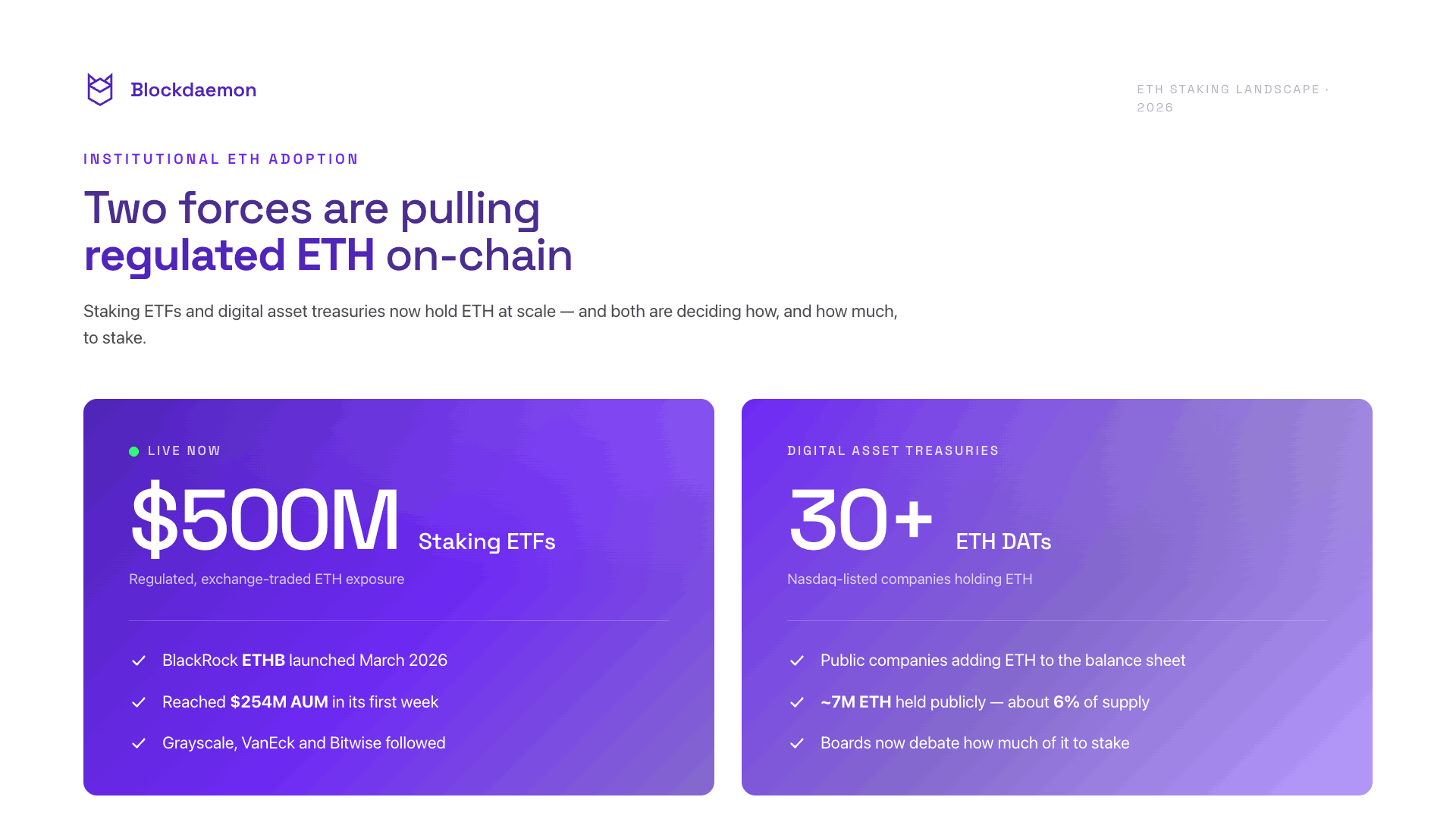
Demetrios’s talk set out what this means in practice. Institutions need staking infrastructure that can hold up under audit, market stress, and day-to-day operations.
Below are the five themes from the presentation.
ETH has a different role in treasury planning because staking can generate protocol rewards.
For boards and treasury teams, that creates a wider set of decisions. How much ETH should be staked? Who controls the signing keys? How are validator rewards tracked? How long could exits take? What happens if a validator is slashed? How does the staking setup fit into audit and risk review?
These questions are becoming more common as ETH moves into regulated products and public company balance sheets.
The data points are already meaningful. More than 38 million ETH is currently staked, around 32% of total ETH supply. The staking base has continued to rise since 2021 across different market conditions. Institutional participation is a major driver of that growth.
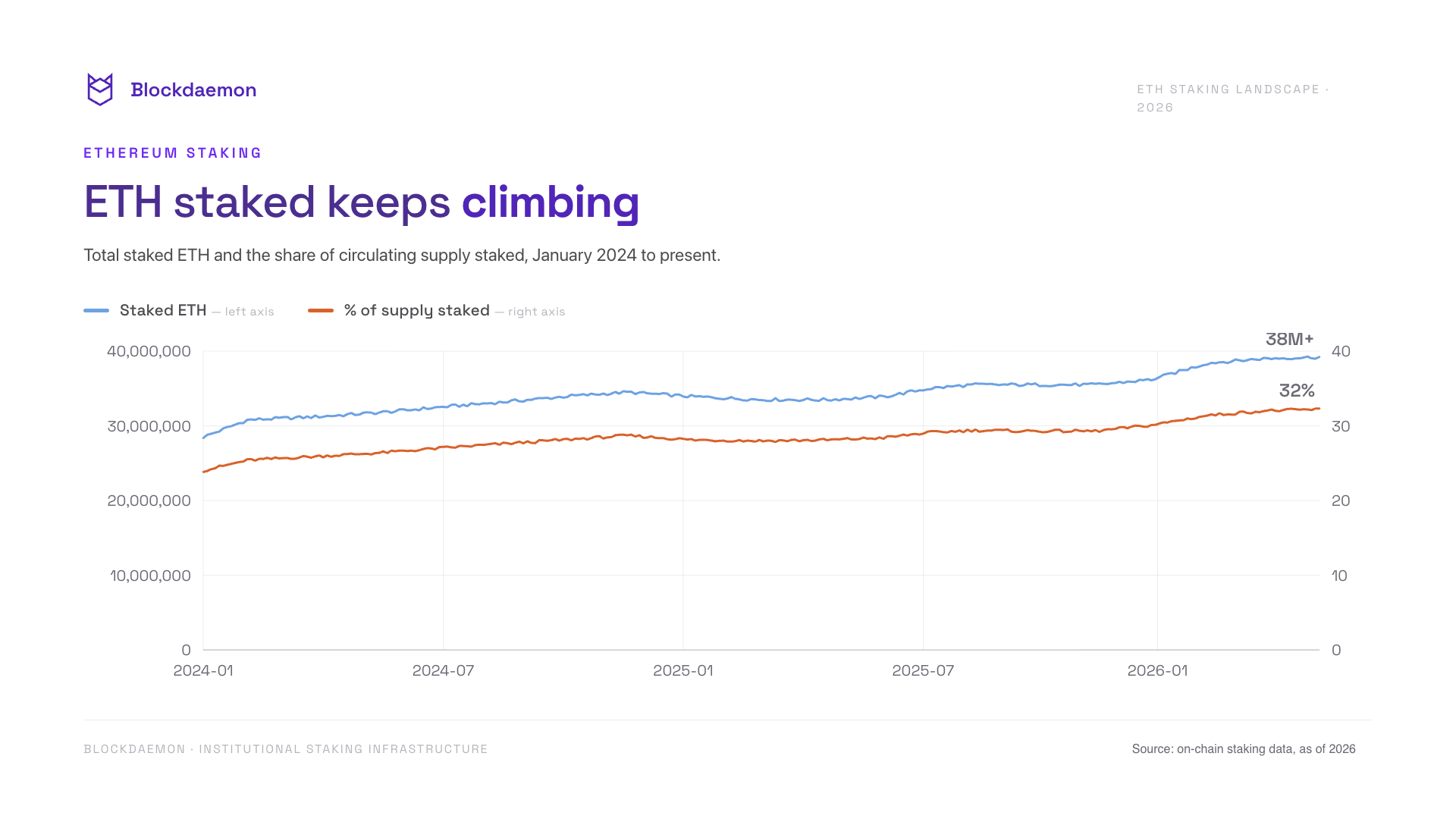
Demetrios’s view was that this growth is structural. ETH staking is being pulled into treasury, ETF, and asset management workflows. That changes the buying criteria for staking providers.
A retail staking product can optimize for access and ease of use. Institutional staking needs to cover policy, controls, reporting, and support. The same validator activity sits inside a much larger operating model.
For institutions, staking starts with rewards. It quickly becomes a question of process.
Security was one of the central points in Demetrios’s presentation.
The most important design principle is separation between validator operations and signing authority. The operator can trigger validator activity. The signing key should stay protected in secure infrastructure.
That means using remote signing, KMS, HSMs, MPC, or distributed validator technology. The key should remain inside a secure environment. Human access to the signing path should be reduced as far as possible.
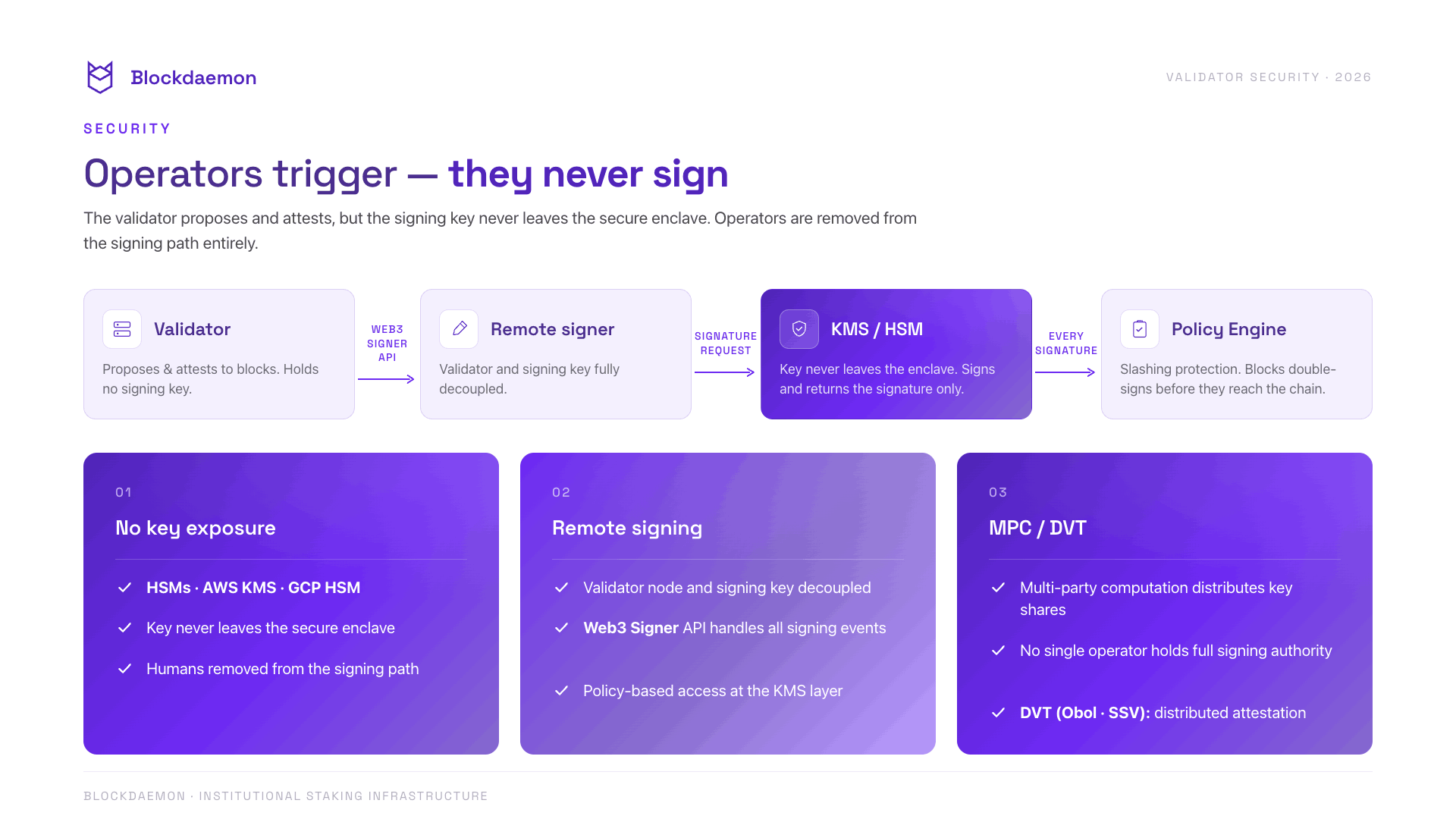
This matters because validator signing is a high-trust function. A weak signing setup can create slashing risk, key exposure, and audit issues. At institutional scale, the risk is amplified by the amount of ETH involved and the number of internal teams that need assurance.
Demetrios compared this shift to the way traditional finance custody has matured. Critical asset movement is governed by policy, access rules, and automated controls. ETH staking needs the same discipline.
A strong staking design gives each system a clear job.
That setup reduces the number of people, systems, and vendors with direct access to sensitive functions.
For regulated institutions, sanctions screening has to be part of the staking flow.
Demetrios highlighted OFAC compliance as a baseline requirement for institutional ETH staking. The relevant control point is block production. Institutions need confidence that proposed blocks are screened before they reach a validator.
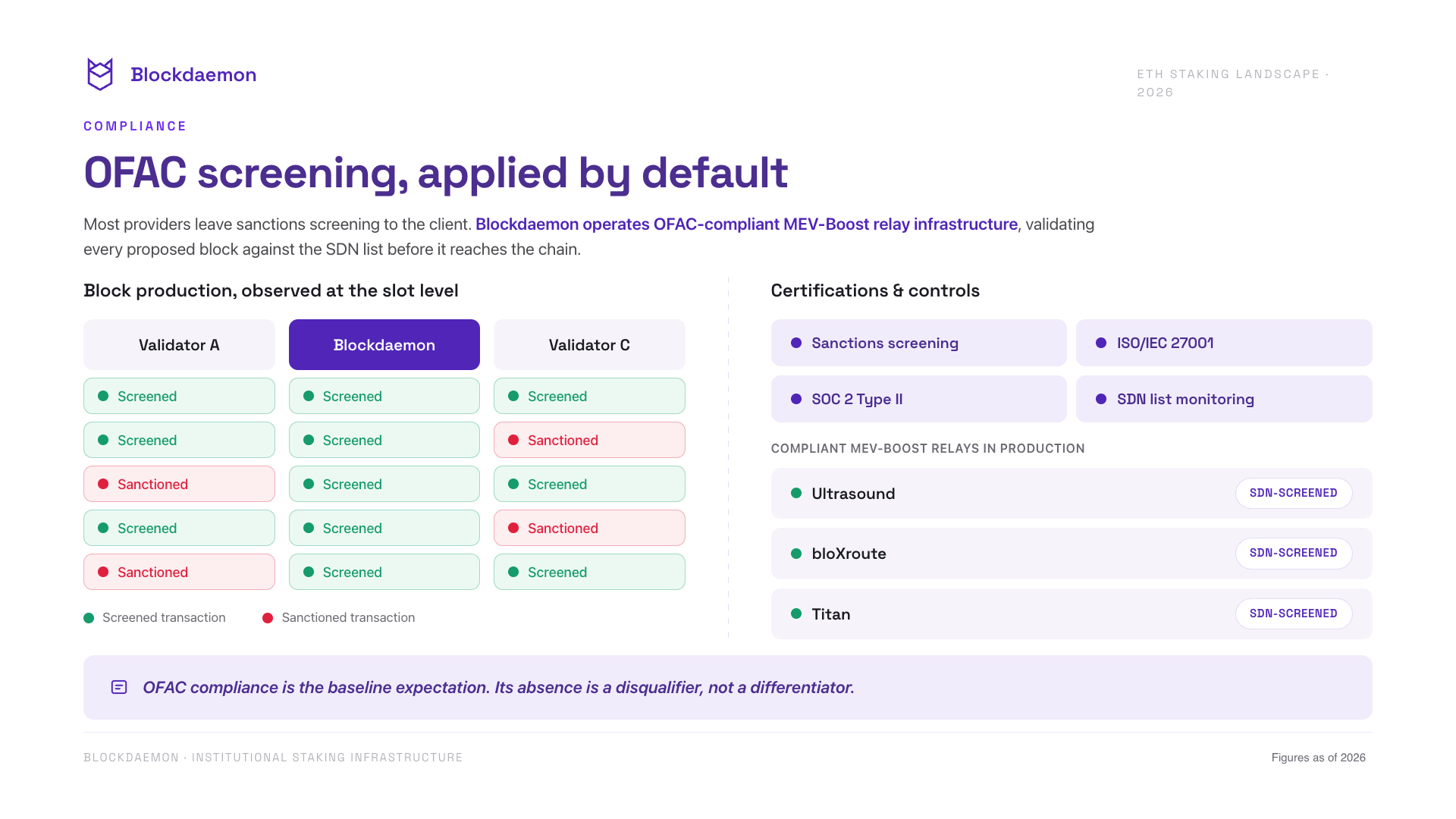
Blockdaemon’s MEV-Boost relay filters sanctioned transaction bundles before they reach the validator. The system uses continuous SDN list updates to support compliant block production.
That gives compliance teams a clearer answer to a direct question: how are sanctioned transactions handled in the staking process?
The same logic applies to audits and vendor risk reviews. ISO 27001 certification and SOC 2 Type II alignment help staking infrastructure fit into the control language institutions already use. Risk teams do not want a special crypto exception. They need evidence, process, and reviewable records.
Good compliance design removes guesswork from the workflow. It shows where screening happens, how lists are updated, how activity is monitored, and how issues can be reviewed later.
For staking providers, the bar is practical. Controls need to operate inside the system, and institutions need proof that those controls work.
Demetrios also focused on two risks that can be underestimated during normal market conditions: exits and slashing.
Ethereum has protocol-level rules for validator exits. Large-scale unstaking can take time, especially during periods of stress. Full exits can take weeks. That timing can create pressure for treasury teams that need cash, collateral, or balance sheet flexibility.
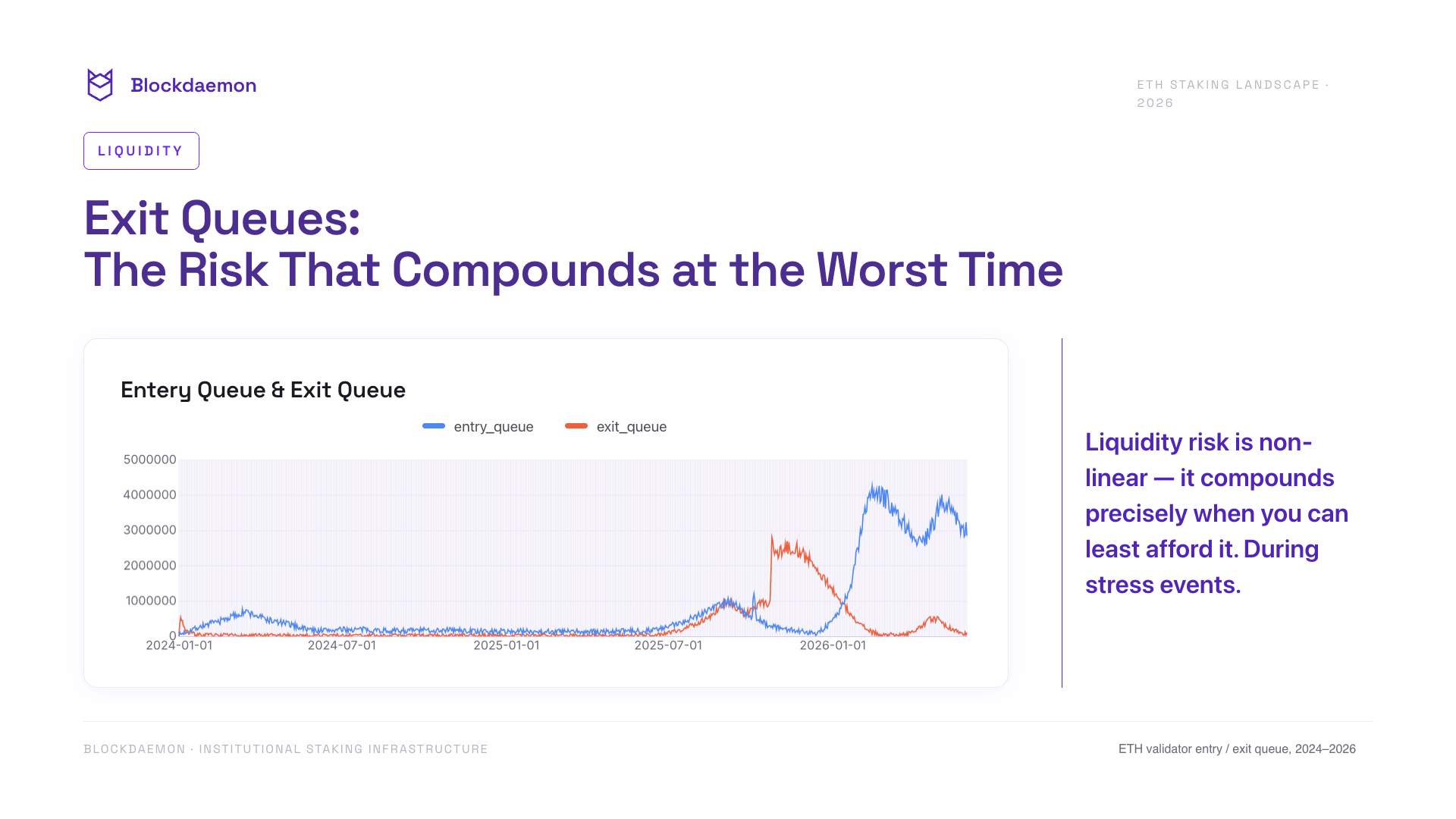
A practical staking program should account for this before ETH is staked.
Demetrios pointed to a toolkit that can include a 10-20% unstaked buffer, clear exit planning, and access to lending facilities through prime broker relationships.
Reward performance still matters. Blockdaemon works to stay above the network average through validator performance, relay selection, uptime, and reward capture. That requires continuous tuning. It also needs to be done in a way that supports the health of the Ethereum network.
The practical goal is to protect capital, reduce operational surprises, and make reward activity easy to explain.
Reporting is part of that work. Finance, tax, and audit teams need more than a monthly total. They need epoch-level attribution across attestations, proposals, sync committees, and MEV. They need history. They need reconciliation. They need data that survives review.
The final theme was operational design.
Institutional staking often touches several systems: validators, custody, wallets, reporting, APIs, monitoring, analytics, support, and incident response. When each part comes from a different vendor, the operating model can become harder to manage.
Each handoff creates work. Security teams need to review another integration. Compliance teams need to understand another process. Engineers need to monitor another dependency. Operations teams need to know who owns the issue when something breaks.
Demetrios positioned the full-stack model as a lower-risk way to run institutional staking.
Blockdaemon’s staking infrastructure includes node operations, staking APIs, reporting APIs, data infrastructure, wallet and custody integrations, monitoring, and support. The benefit is a single operating model: one SLA, one contract, one security model, and one support path.
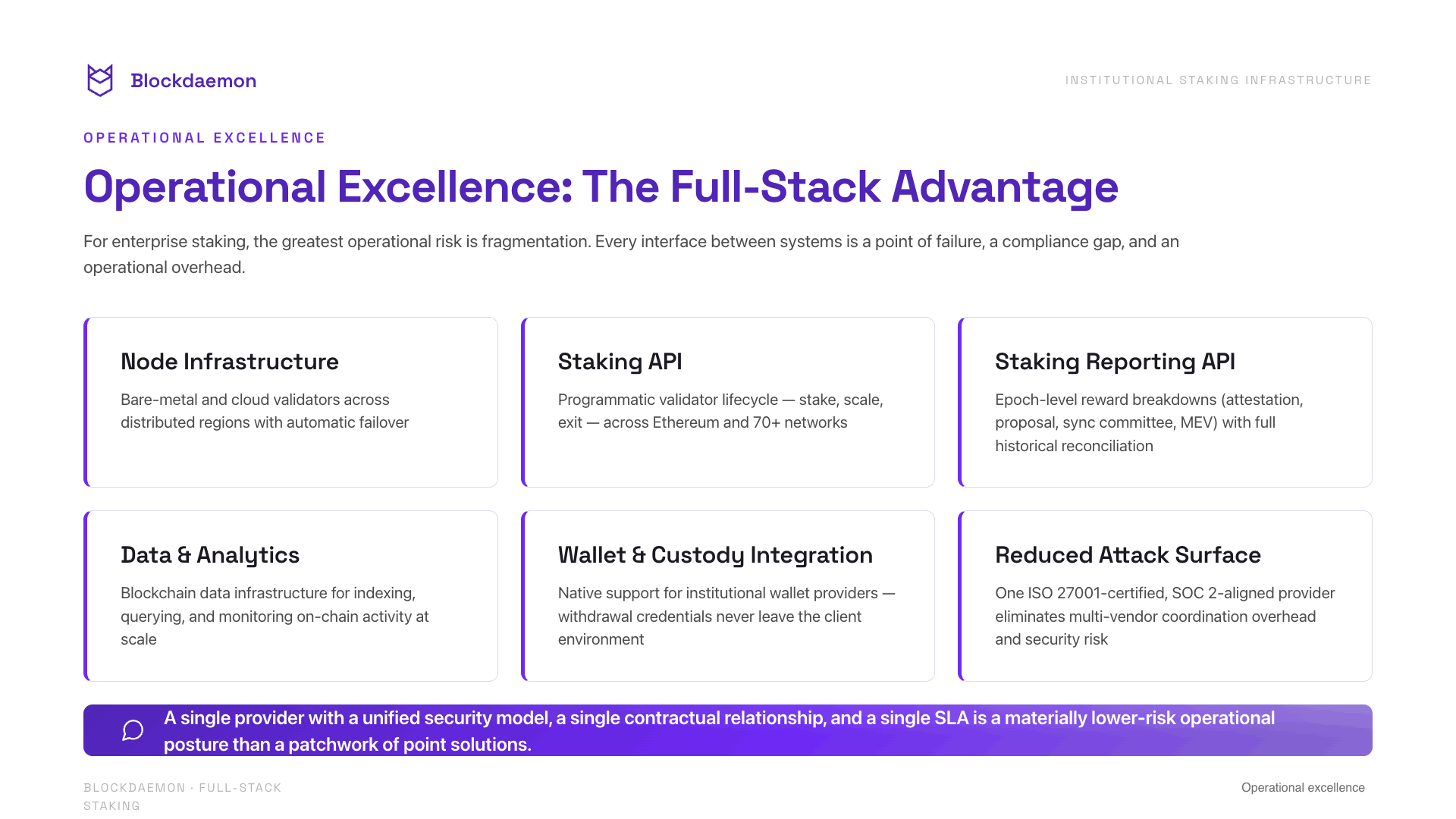
That structure matters during incidents. It also matters during procurement, audit, and day-to-day operations.
Institutional staking depends on many small details working consistently. Validators need to stay online. Rewards need to be tracked. Blocks need to be screened. Keys need to remain protected. Reports need to be reconciled. Exit plans need to be ready before they are needed.
A full-stack provider reduces the number of seams in that process.
Demetrios’s ETHConf presentation pointed to a market that is getting more serious about ETH staking.
ETH ETFs are creating new routes into the asset. Public companies are adding digital assets to balance sheets. Around 30-35% of ETH supply is staked today, and Demetrios outlined a path where that could reach 40-50% within three years, with institutions helping drive that growth.
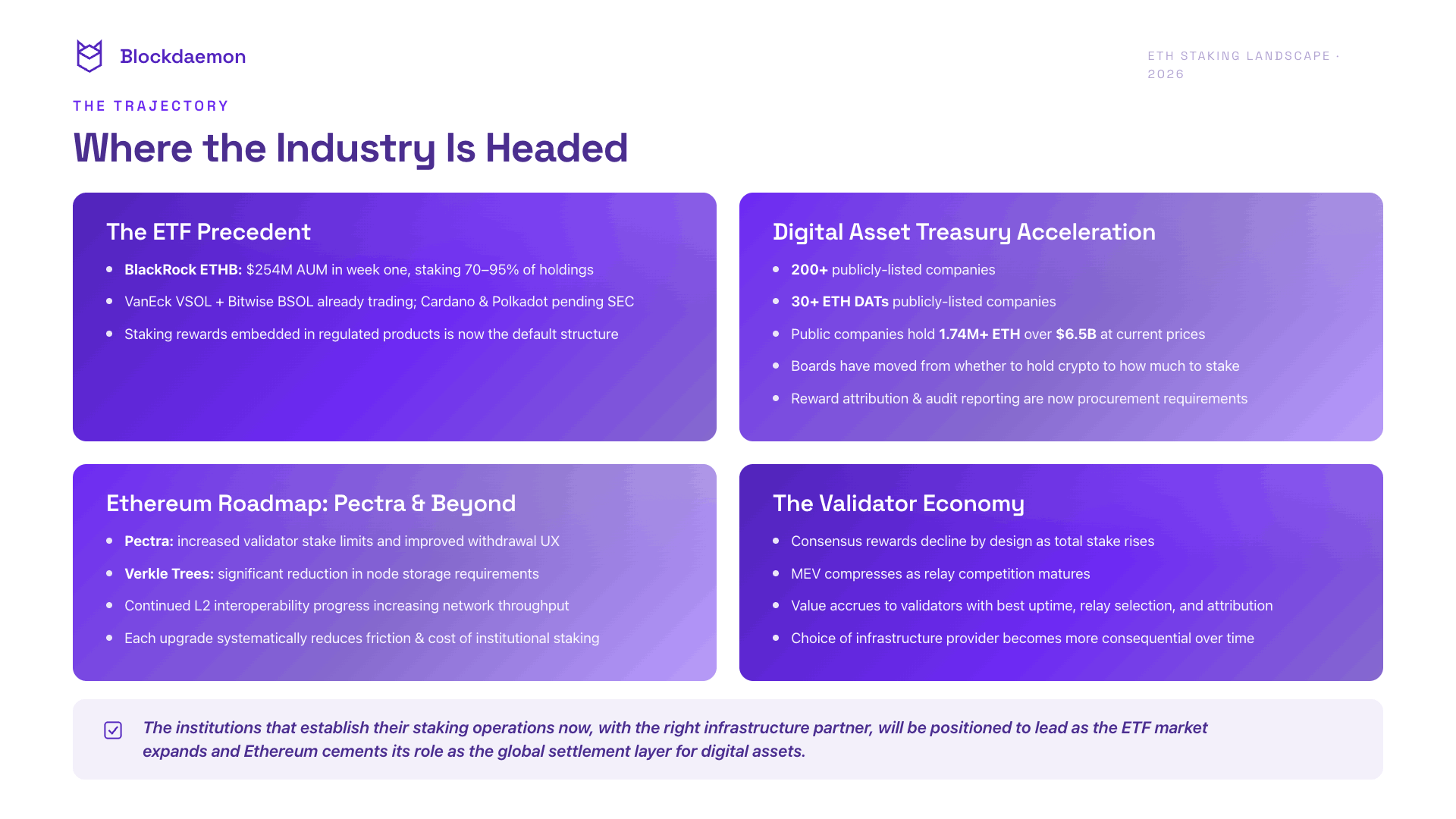
That level of participation will put more pressure on staking providers.
Rewards are expected to compress as participation grows. Provider selection will depend more on uptime, relay selection, validator operations, reporting quality, compliance controls, slashing cover, and liquidity planning.
Institutions need ETH staking infrastructure that can stand up to real operating conditions. Demetrios’s presentation made that clear across each part of the stack: keys, validators, relays, exits, rewards, reporting, and support.
The organizations that build these staking operations with the right infrastructure partner will be better prepared as ETH takes a larger role in institutional digital asset strategies.
Blockdaemon provides institutional-grade Ethereum staking infrastructure built for regulated capital.
With $10B+ in assets under stake, support for 70+ networks, a 99.9% uptime SLA, ISO 27001 certification, SOC 2 Type II alignment, 100% slashing insurance, OFAC-compliant infrastructure, staking APIs, reporting APIs, and full-stack validator operations, Blockdaemon helps institutions stake ETH securely, compliantly, and at scale.
Contact us to learn how Blockdaemon can support your institutional staking strategy.


Contact us to learn how we can help you power your blockchain business.