Get Started with
Blockdaemon Today!
Contact us to learn how we can help you power your blockchain business.

Unparalleled Security & Compliance
Seamless Integration & Scalability
Dedicated Customer Support

During the mainstage DAS NYC 2026 panel discussion on 25 March 2026, Tom Zschach, Chief Innovation Officer at SWIFT, and Konstantin Richter, CEO and Founder of Blockdaemon, shared a grounded view of where global payments may go next.
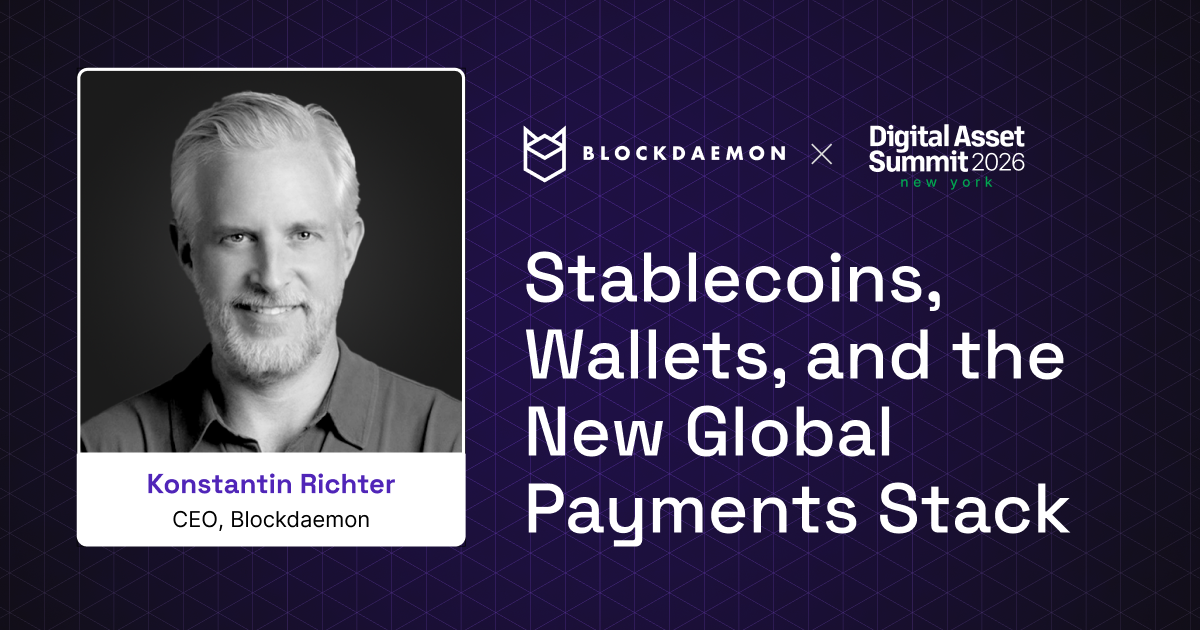
During the mainstage DAS NYC 2026 panel discussion on 25 March 2026, Tom Zschach, Chief Innovation Officer at SWIFT, and Konstantin Richter, CEO and Founder of Blockdaemon, shared a grounded view of where global payments may go next.
The discussion led to a few key takeaways. First, both speakers framed the rise of agentic payments and on-chain settlement as real, but still early for large institutions. Next, they focused on what banks will need for adoption: control, audit, legal clarity, and strong operating rails. The most important messaging to remember was that the future stack will not replace institutional finance. It will connect to it.
Below are the five themes that emerged from the discussion.
Tom Zschach defined the core shift in simple terms: “What we’re really talking about is that instead of a human making a decision directly, it’s going to be done by an algorithm”. But Tom also made clear that banks are not starting from zero. Many financial firms have used automated systems for years in trading, hedging, and cash movement.
Konstantin brought that idea closer to the operating layer. He described agentic payments as “software-driven payment orchestration”, but stressed that payment logic alone is not enough. It still has to connect to liquidity, settlement, security, reconciliation, and the rules banks already follow.
As mentioned during the panel, the Blockdaemon Institutional Vault serves as a tool built for this kind of controlled automation. As Konstantin explained, Blockdaemon offers on-prem wallet and signing capabilities for institutions with multiparty policy controls, kept encrypted on-prem. In that sense, Blockdaemon Institutional Vault is a control plane for institutions that want automation without giving up governance.
The middle of the panel focused on a core issue for banks: how to automate without losing accountability.
Tom Zschach stated clearly that, “There are no black boxes in finance”. In an institutional setting, no team can tell an auditor, regulator, or risk manager that a system acted on its own and no one knows why.
Konstantin made the same point in a similar way: “You have to separate accountability from execution”. The execution layer can be software-driven. The accountability layer still belongs to people.
That distinction also ties back to the Blockdaemon Institutional Vault with an encrypted policy engine. Konstantin explained that institutions still need to define roles, permissions, multiparty approval paths, and transaction limits. In other words, humans design the policy framework first. Then software executes within it. That is a useful model for banks, where programmable workflows, but inside a clear rule set.
A third theme came through in Konstantin’s comments on infrastructure beyond signing. As noted during the talk, Blockdaemon also provides the nodes needed for liquidity sequencing, monitoring, and the rest of the operational stack that supports agentic payments and transaction flow.
That matters because the market often talks about wallets as if they are the whole answer. The panel suggested otherwise. For institutions, the wallet is one part of a broader stack. It has to sit alongside network access, transaction monitoring, settlement logic, and operating visibility.
Tom Zschach made a similar point from the asset side. Using the idea of a “programmable container,” he argued that tokenized instruments will need built-in context, not just transfer capability. Assets will need machine-readable facts around what they are, how they settle, and where they can be held. At scale, those checks cannot sit in PDFs or manual review queues.
Taken together, the panel pointed to the need for a payment stack that combines secure signing, connected infrastructure, and embedded rules.
The panel also offered a balanced view of regulation.
Konstantin Richter said many institutions are still waiting for certainty before moving from pilots to live workflows. As Konstantin put it, “the minute that there’s any gray area legally, institutions will not engage in it”. That is why, in Konstantin’s view, the market is still waiting for fuller clarity before real flow begins at scale.
Tom Zschach approached the issue from a different angle, saying that regulators have a defined role and that markets move when final rules are in place. His point was that the main blocker is not speed. It is certainty.
Both views lead to the same outcome that institutional adoption hinges on legal clarity, risk comfort, and production-grade controls.
The panel ended with a practical view of where the market is heading.
Konstantin Richter said it plainly: “They’re not going to replace one another… They’re going to interconnect”. On-chain rails and legacy rails will need to work together. Digital networks are strong at speed, operational efficiency, and reducing friction. But banks still need consumer protection, compliance, and trusted operating models.
Tom Zschach added to this from SWIFT’s side. The value of standards, workflow, traceability, and institutional trust does not go away when new assets arrive. If anything, those things matter more.
Tom Zschach, Chief Innovation Officer at SWIFT, emphasized the core requirements for institutional adoption. These are trust, traceability, and integration. Konstantin Richter, CEO and Founder of Blockdaemon, focused on the infrastructure needed to support that model at scale.
Konstantin captured the broader shift well when he said the market should be “less about ideology and more about systems design”.
The next payments stack is starting to take shape around programmable workflows, policy-based controls, and stronger links to existing financial rails. For institutions, that is what will make digital asset infrastructure practical, scalable, and fit for real-world use.


Contact us to learn how we can help you power your blockchain business.