Get Started with
Blockdaemon Today!
Contact us to learn how we can help you power your blockchain business.

Unparalleled Security & Compliance
Seamless Integration & Scalability
Dedicated Customer Support

A practical introduction to agentic wallets.
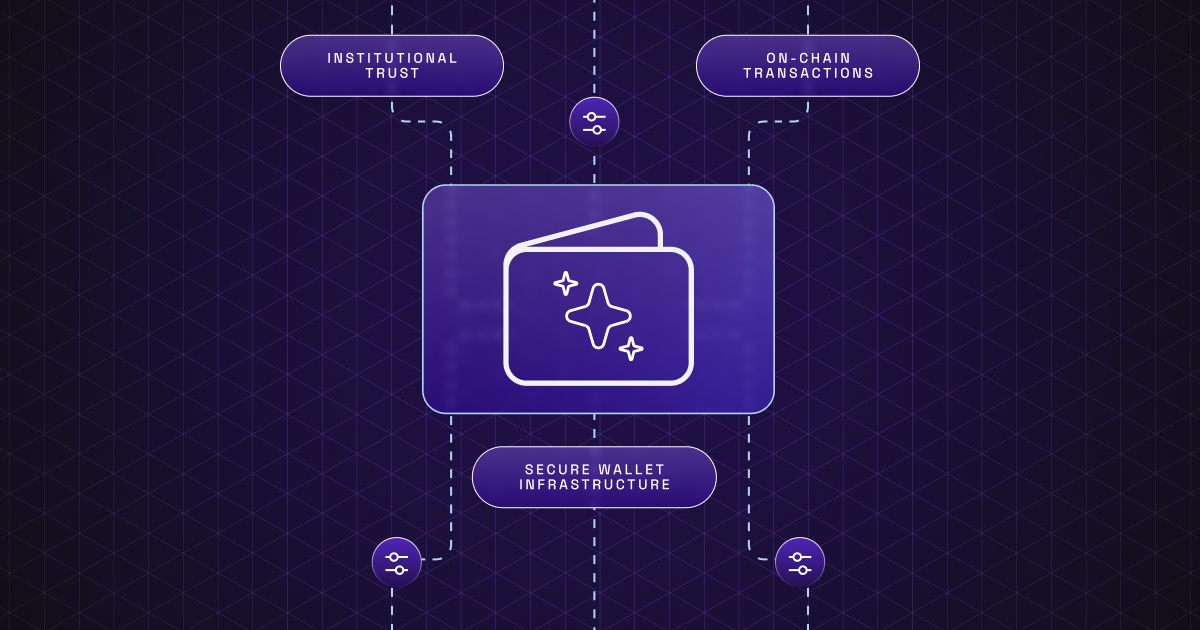
In 2026, the term agentic workflows is everywhere. For the uninitiated, this basically means AI-driven workflows in which systems (agents) can act autonomously on behalf of an organisation, not simply analyse or respond to prompts.
Within financial operations, this includes AI‑driven agents that can analyse data, make decisions, and even execute on‑chain transactions. To do so, they need what is increasingly described as an agentic wallet.
The benefits of agentic wallets include greater efficiency, faster execution, and continuous operation. The risks go without saying.
So, this begs the question: how can institutions embrace the benefits of autonomous agents while keeping control intact?
Imagine a fleet of autonomous cars that can navigate city streets, make route decisions, and adapt to traffic conditions. All in real time. You trust each one to operate independently, but within defined limits; mapped routes, speed restrictions, sensors, and overrides in case something goes wrong.
Replace the cars with AI agents, and the road network with financial systems and you have a neat analogy; autonomy works best when it is supported by robust infrastructure, not by blind trust in the individual agent.
Institutional autonomy depends on secure frameworks that allow agents to operate within controlled boundaries. Infrastructure defines what is possible, what is restricted, and when human oversight is required.
If financial institutions are going to let agents initiate or influence transactions, the focus must be on the surrounding environment, and whether it is secure enough to contain mistakes, limit risk, and preserve oversight.
In practice, that means these AI-driven workflows need to be built on infrastructure that assumes fallibility.
An agent may be useful, fast, and context-aware, but it can still misfire. It can still operate on flawed inputs. It can still be manipulated, interrupted, or pushed beyond its intended remit.
The institutional response is architecture that reduces the consequences of error.
Agentic finance is ultimately about redesigning control for a world in which software is taking a more active operational role.
Secure wallet technologies such as MPC support this by reducing the risks associated with single-key exposure. Policy controls can limit what an agent is allowed to do, where it can send assets, and under what conditions. Escalation paths can ensure that higher-risk actions still require human approval. Compliance checks can also be embedded into the transaction flow itself, rather than bolted on afterwards.
This is the broader problem Blockdaemon is focused on solving: making autonomy governable.
The challenge lies in creating an environment in which AI-driven action can be constrained, supervised, and trusted at an institutional level.
Autonomous agents will become the norm across a whole range of workflows. The firms that stand out in the coming phase will be those with the most robust infrastructure around them.


Contact us to learn how we can help you power your blockchain business.